SO-ARM101 VLA Real-Robot Deployment
My main embodied AI project: teleoperation data, policy training, inference integration, real-robot rollout, and failure analysis.

Goal
This is my main embodied AI project. I built a real-robot pickup-and-putdown loop around SO-ARM101: teleoperation data collection, dataset organization, policy training, inference integration, rollout evaluation, and failure analysis.
The key value is that the work connects LeRobot/OpenPI, ACT, Diffusion Policy, SmolVLA, and pi0/pi0.5 to a physical robot task instead of staying only at paper reading or offline code execution.
Hardware and Data
- Platform: SO-ARM101 leader/follower arm setup.
- Task: pickup, transport, and putdown.
- Data: 99 episodes, about 28k frames.
- Logged signals: camera observations, joint states, actions, task stages, and success/failure notes.
Model Routes
- ACT: action chunking for low-frequency control; I focused on chunk length, motion smoothness, and accumulated error.
- Diffusion Policy: action-sequence modeling through diffusion; I focused on sampling steps, inference latency, and real-robot stability.
- SmolVLA: visual/language-conditioned action prediction; I focused on instruction format, action interface, and deployment cost.
- pi0/pi0.5: deployment validation and small-sample evaluation on SO-ARM101, not from-scratch foundation-model training.
Deployment Loop
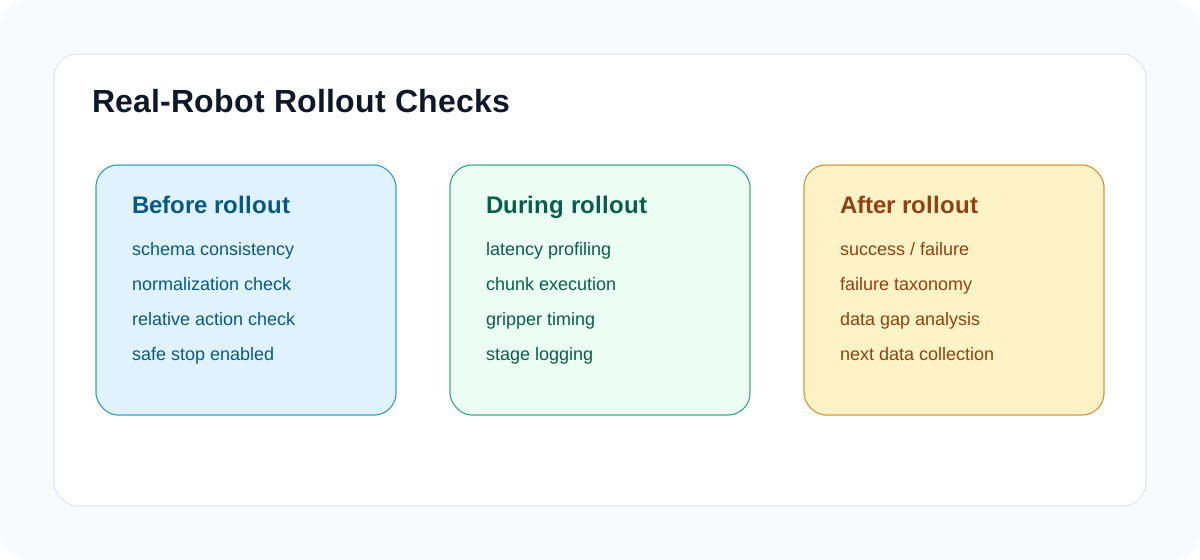
The main engineering issues were:
- Dataset schema and training configuration consistency.
- Correct action normalization and denormalization.
- Matching relative actions with robot coordinate conventions.
- Matching action chunking with the robot control frequency.
- Inference latency, abnormal actions, and safe stop behavior.
Evaluation
The public claim is intentionally bounded: I completed the SO-ARM101 data-training-deployment loop; ACT, Diffusion Policy, and SmolVLA have rollout evidence; pi0/pi0.5 completed small-sample pickup/putdown deployment validation. The small-sample result validates the deployment pipeline, not open-world generalization.
Failure Analysis
The main real-robot failure sources are:
- Camera-view or object-initial-position shift.
- Incorrect normalization or relative-action convention.
- Inference latency causing state-action mismatch.
- Gripper timing, grasp pose, or putdown height instability.
- Limited data coverage under unseen conditions.
Next Experiments
- Expand left / center / right initial positions.
- Add object, lighting, camera-view, and language-paraphrase variations.
- Track stage pass rate instead of only final success rate.
- Compare failure types across ACT, Diffusion Policy, SmolVLA, and pi0/pi0.5.
- Use failure examples to guide the next data collection and tuning round.
Boundary
This project demonstrates real-robot data, training, deployment, evaluation, and failure-analysis ability. It should not be read as from-scratch training of a general-purpose embodied foundation model.